Showing posts with label Pays des Illinois/Illinois Country. Show all posts

Friday, April 18, 2014

Digging St. Louis

A piece of tin-enameled ceramic found at what archaeologists say is the site of a former French colony in St. Louis.
Photo: Steph Zimmerman/St. Louis Public Radio.
The French origins of St. Louis were again in the news this month, with the report that archaeologists have uneartherd some interesting remains under a highway overpass just south of the city's famed arch.  They found traces of a post-and-earth house built c. 1769 as well as some artefacts including sherds of tin-glazed earthenware.  NPR has the story here. 

I say again in the news because of this and this.  Good people of St. Louis, we salute you for keeping French colonial heritage alive!

P.-F.-X.

Thursday, April 3, 2014

The Ground Beneath Our Feet

What do you get when you bring together a former NPR radio producer and a trio of talented French teenage filmmakers?  A road movie, provisionally entitled The Ground Beneath Our Feet, set in the present day American Midwest... and the Pays des Illinois of the 1760s! 
 
Theo Reynal, one of the three Young French cinematographers,
scouting locations in St. Louis.  Photo: Riverfront Times. 
The St. Louis Riverfront Times reports that Seán Collins will be working with Aurélien Loevenbruck, Alex Fortineau and Theo Reynal, for whom is a school project at the ESRA film academy in Rennes, France.  Fortineau is writing the contemporary portion of the plot, which follows an erstwhile American living in France who is travelling to St. Louis to confront a family tragedy but finds himself stranded in Albuquerque, New Mexico, with no money and no transportation.  Collins, meanwhile, is writing the historical portion of the film, which will follow a French settler "who sets off for New Mexico after Great Britain takes control of the territory east of the Mississippi", reports the RTF.

The three Frenchmen have just spent two weeks scouting locations in and around St. Louis, and will be back this summer to film.

Incidentally, France warns its citizens not to visit North St. Louis : "Avoid the northern neighborhood between the airport and the town center, but the shuttle from the airport is safe," advises the French governmental website as of last year...

P.-F.-X.

Sunday, February 16, 2014

STL 250

J'ai de toute évidence négligé, en faisant le décompte des anniversaires qui seront célébrés en 2014, de mentionner le 250e de la fondation de St. Louis (Saint-Louis), Missouri.  Oups!
 
À l'été 1763, le gouverneur de la Louisiane, Jean-Jacques Blaise d'Abbadie, attribuait au marchand nouvel-orléanais Gilbert-Antoine de Saint-Maxent le monopole du commerce dans le haut de la colonie.  La nouvelle que la France venait de céder l'est du Mississippi à la Grande-Bretagne, suivant les termes du Traité de Paris, donnait encore plus d'importance au projet puisque les établissements clefs de la Haute-Louisiane, alias Pays des Illinois, se trouvaient sur cette rive.  Pierre Laclède et son beau-fils, René Auguste Chouteau, furent dépêchés avec une vingtaine d'hommes dans la région pour établir un nouveau centre, sur la rive ouest.  Ils identifièrent un site propice à la fourche du Mississippi et du Missouri, puis y entamèrent les travaux de construction le 15 février 1764. 
 
Laclède donna le nom de Saint-Louis à l'établissement qui, bientôt, attira plusieurs familles françaises de Cahokia et du Fort de Chartres, sur la rive est du fleuve, qui cherchaient à fuir l'autorité de leurs nouveaux maîtres britanniques.  En 1765, Saint-Louis devint officiellement le siège administratif de la Haute-Louisiane, territoire désormais espagnol : l'année précédente, il avait été révélé que la Louisiane à l'ouest du Mississippi avait été cédée à l'Espagne suivant les termes du traité secret de Fontainebleau de 1762.  Territoire espagnol en théorie, car ce n'est qu'en 1770 que le commandant français de Saint-Louis fut remplacé par un officier espagnol.  La population des lieux conservera pour près d'un siècle par après son noyau français, dont les descendants portent encore fièrement l'héritage aujourd'hui. 

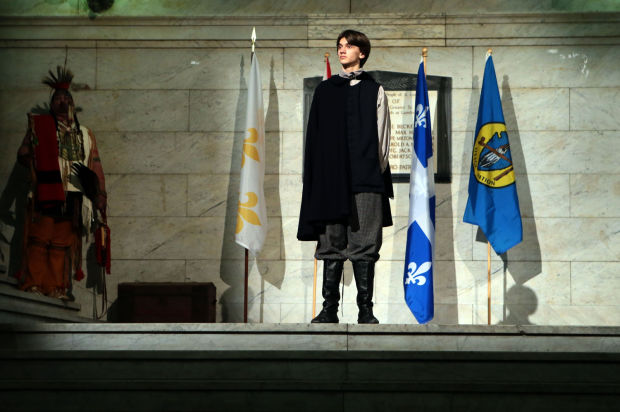
Reenactment of the Founding of St. Louis
À l'hôtel de ville de St. Louis: le jeune René Auguste Chouteau incarné;
en arrière-plan, quelques drapeaux et un Osage.  Photo: St. Louis Today.
 
L'année de commémoration et de célébration a été lancée hier, le 15 février, jour anniversaire de la fondation, avec une reconstitution théâtrale dans le hall d'entrée de l'hôtel de ville de St. Louis.  On a annoncé une initiative intéressante: de nouveaux panneaux d'affichage vont venir rappeler les noms de rue d'origine dans le centre-ville.  Une autre reconstitution, prévue à l'extérieur sur les parterres de l'Arche monumentale qui sert d'icône à la ville, a été moins fréquentée en raison du mauvais temps.  St. Louis Today rapporte tout cela.  Le programme des festivités, au site www.stl250.org, annonce quelques autres manifestations historiques.

P.-F.-X.

Thursday, October 24, 2013

Kudos to the Kaskaskia-Cahokia Trail

The Kaskaskia-Cahokia Trail is one of this year's winners of the Richard H. Driehaus Preservation Awards.  These awards are given out by Landmarks Illinois, a nonprofit group that advocates for the protection of historic properties, to recognize excellence in preservation.  In 2000, the Kaskaskia-Cahokia Trail had in fact been listed on the association's list of 10 Most Endangered Landmarks.

Picture
Fort de Chartres, just west of Prairie du Rocher, in Randolph County, Illinois.
The trail, which as its name suggests linked Kaskaskia and Cahokia in the Pays des Illinois, is first mentioned in 1718 in conjunction with the building of Fort de Chartres and shows up for the first time on maps in the 1730s.

For more you can check out the Kaskaskia-Cahokia Trail on Facebook.

P.-F.-X.

Wednesday, September 26, 2012

Digging It

Is there a better occasion for father-and-son bonding than fashioning a dugout canoe out of an old cottowood tree and paddling it down the mighty Mississippi River?  I don't think so. 

Earlier this month Dean Campbell, a 78 year-old former teacher and longtime historical enthusiast, and one of his sons, Dave Campbell, 50, of Springfield, Illinois, did just that.  Campbell senior spent the last five months carving out the canoe with axe and adze.  On September 1st it was launched on a seven-day journey from Beardstown, Illinois, along the Illinois River and down the Mississippi to St. Louis.  Campbell designed the 125-mile trip so that fourteen different people, paddling a day each in pairs, could take part in the adventure; he and his son reserved the final leg for themselves , paddling from Alton on to St. Louis on September 7th.  Here is a report published in the Illinois Times just before the launch, and here is another published in the River Bend Telegraph as the dugout was nearing its destination.

The canoe's test run.  From the Illinois Times.
Campbell declared that he intended to follow up by taking part in events at Fort de Chartres, the reconstructed eighteenth-century French fort and state historic site near Prairie du Rocher, just south of St. Louis.

I've long entertained a special fondness for the dugout canoe.  Its sleek cousin, the birchbark canoe, gets all the fame and glory.  As far as our collective historical memory of New France and Early Canada is concerned, birchbark is king.  With good reason, to be sure, but we shouldn' forget that dugout canoes were used extensively by Natives and Newcomers along the Mississippi River and its tributaries, where the mighty birch did not grow, but also throughout more northerly climes: in the Maritimes, along the St. Lawrence River, and through the Great Lakes.  It was a sturdy and practical watercraft.  Samuel de Champlain observed how the native inhabitants of what is now New England went about fabricating theirs: "After much effort and time used to cut the biggest and tallest tree they could find with stone hatchets, they strip the bark from all sides except one, where they burn it in many places... When it is hollow enough, they scrape it completely with stones."  Dugout construction persisted among both Aboriginals and French settlers, with metal tools replacing stone ones, until the nineteenth century.

Several dugouts can be found in museum collections today.  The Canadian Museum of Civilization has a couple in storage, including one found on Île d'Orléans by Marius Barbeau, the father of Canadian ethnology, tucked away in a barn where it had long since been repurposed as a grain container.  Dugouts have also survived the centuries in waterlogged environments.  One, dating back to the fifteenth century, was found by an amateur diver beneath Lac Gour, in the Laurentians, in 1986.  At last notice it was on display at the Pointe-du-Buisson museum, southwest of Montreal (an interesting writeup of its discovery and conservation treatment can be found here).  Another, uncovered on a beach near Val Comeau in northeastern New Brunswick in 2003 and revealed to date to the sixteenth century, has been on display at the New Brunswick Museum (for the description of a related research project, check here).

I dig the dugout.  Do you?

P.-F.-X. 

Wednesday, September 12, 2012

Sainte-Geneviève à l'honneur

Sainte-Geneviève ou plutôt Ste. Genevieve, Missouri, figure au palmarès des dix petits villages les plus "cool" aux États-Unis dévoilé ce mois-ci par par BudgetTravel.com.  C'est surtout à son patrimoine colonial français, semble-t-il, que cette collectivité de 4 410 habitants doit l'honneur d'occuper la neuvième position.  "La première chose que vous remarquerez," déclare la mention, "c'est à quel point Ste. Genevieve ressemble à un village français." 

Maison Bolduc, Ste-Geneviève, Missouri.

Rappellons que le village de Ste-Geneviève fut fondé à la fin des années 1740 par des colons Canadiens établis depuis un certain temps sur la rive opposée du Mississippi.   Avec Kaskaskia, Cahokia, Prairie du Rocher et Fort de Chartres, Ste-Geneviève formait le noyau de la présencec française au Pays des Illinois.  Or, si Ste-Geneviève parvient à retenir l'intérêt de nos jours, c'est surtout en raison de son remarquable patrimoine architectural.  On y retrouve en effet quelques bâtiments anciens qui, quoique construits après la fin du Régime français, témoignent de cette présence française d'origine.  Le palmarès de BudgetTravel cite notamment la Maison Bolduc alias Bolduc House, musée d'histoire régionale et plus ancienne maison de la ville.  Sa construction, dont le schéma de type "poteaux-sur-solle" est, comme le type "poteaux-en-terre", caractéristique, remonte à 1792.